
Top Ethiopian Day Trips, Addis Ababa Excursions, Short Holidays, Stopover Trips, Addis Ababa City Tours on Long Haul Flights
Our Addis Ababa is a unique city which has been Ethiopia’s political an economic centre since its establishment in 1886. Its rich architecture reflects various international influences and modernising projects b successive Ethiopian leaders. Addis Ababa, today the capital of the African Union, as well as of Ethiopia, has a remarkable history.
It began in the 1880s when King Menelik, ruler of Shewa in central Ethiopia, established his camp in the Entoto mountains overlooking the present capital. His consort, Queen Taitu, shortly afterwards moved down to the nearby plain of Finfinne, also known as Filwoha, to bathe in its thermal waters. Addis Ababa, then situated between these two sites, came into existence in 1887,when Taitu gave it its Amharic name: Addis Ababa, or New Flower.
In the last 140 years, Addis Ababa has grown from a settlement around Filwoha hot springs to the diplomatic capital of Africa. Addis Ababa is an indigenous city where local Ethiopian cultures find their place, a cosmopolitan city of expatriates working in the diplomatic missions and the capital of the vibrant Oromia region.
Addis Ababa City Tour, Museums, Markets
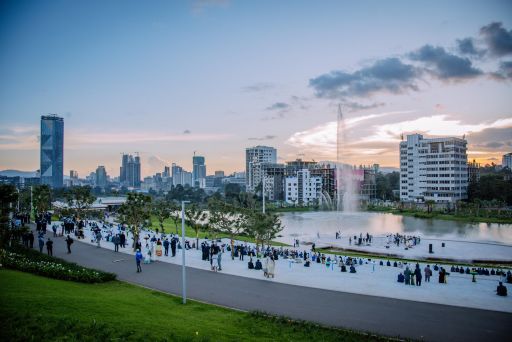
A city tour of Addis Ababa
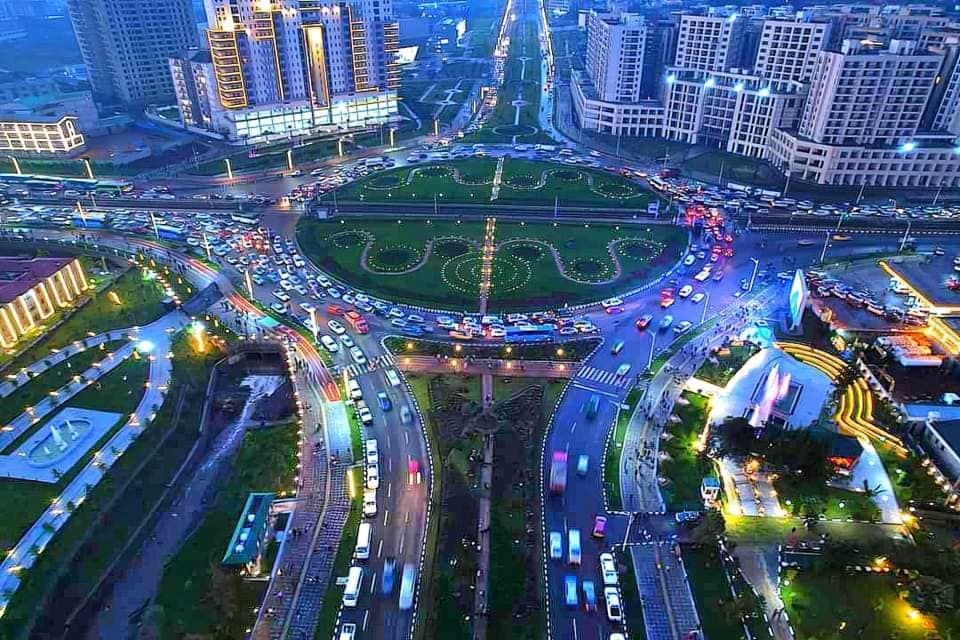
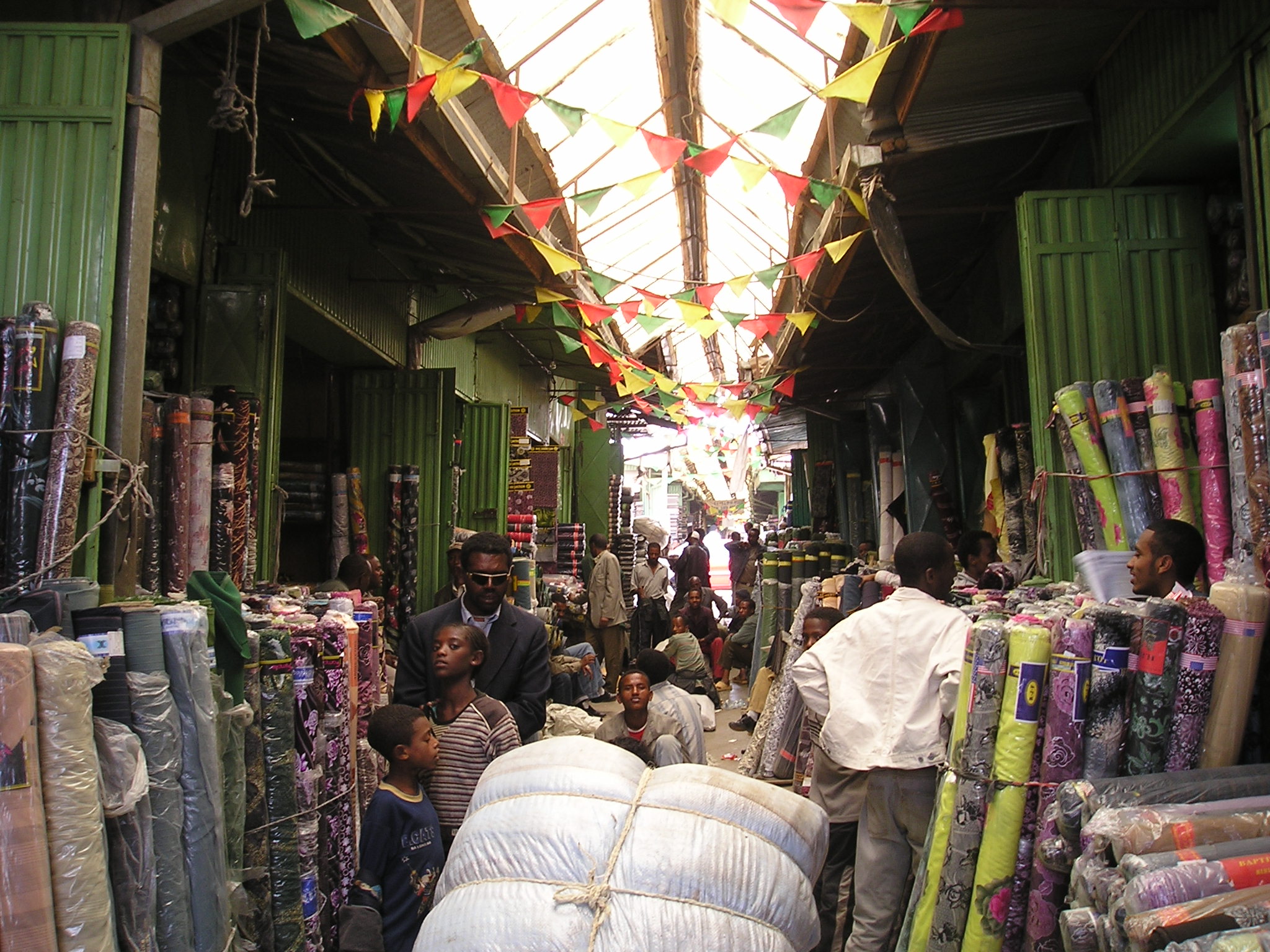
Addis Ababa city tour offers visitors large number of attractions ranging from old treasures in its museums to cathedrals and from the largest open air market Mercato to small street vendors from its modern restaurants to cultural restaurants.
Thanks for the new corridor city renovation projects the city offers bike lanes and pedestrian walking sides, fountains, parks and green spaces so much more. It won’t be too much to include the city now as one of the most vibrant and beautiful cities in the world.
Addis Ababa is am important city in Africa as it is considered the diplomatic capital of Africa. It is in Addis Ababa, the head quarters of the African Union is situated.
Enjoy Addis Ababa Food, Cafes and Restaurants
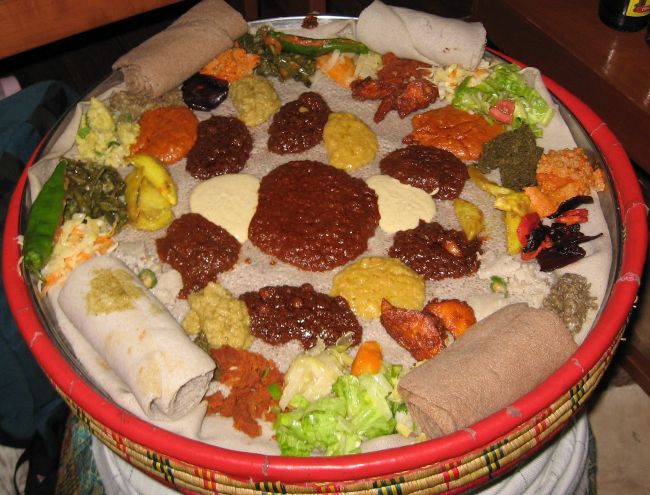
Ethiopian cuisine is varied and original. Injera, is made from teff is a highly prized staple. teff only grows in the highlands is among the tiniest grain the world.
The main dish is placed in the centre of the injera with small portions of other foods surrounding it – a bit of each infront of every person. the variety of spices produces a vividly colourful meal.
In general, the most common dishes are sauces and stews of different types called wot. , made from meat, or fish, or vegetables. their names depend on composition doro wot is chicken stew, mutton is called beg or beef. Try very spicy sauces which usually accompany Ethiopian dishes.
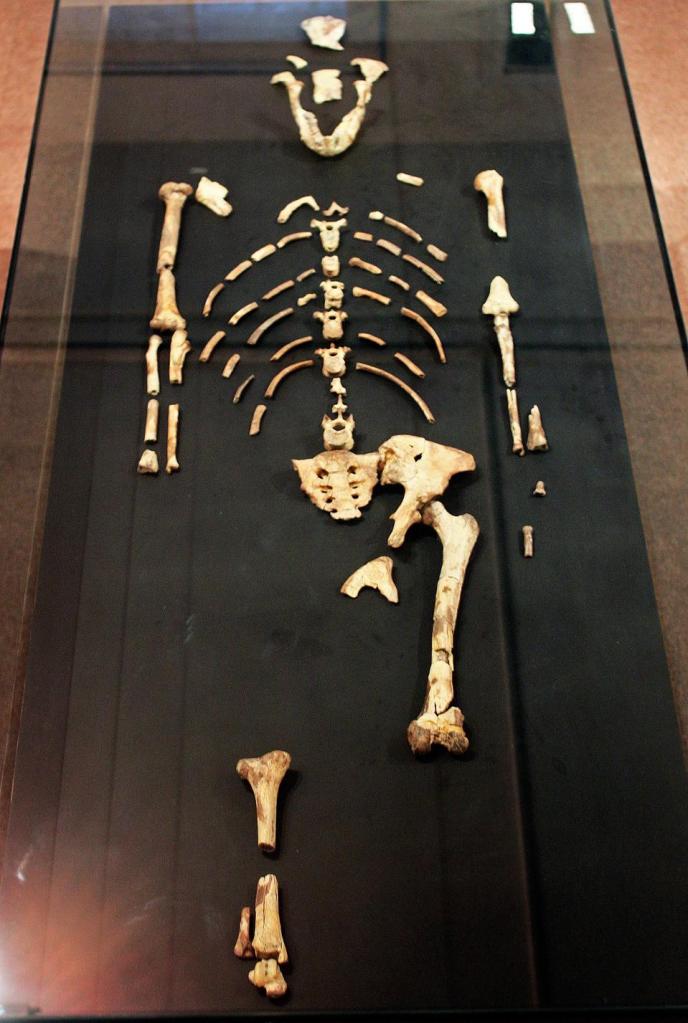
Fossil remains of Lucy at the National Museum
Visit fossil remains of Lucy the treasure of the national museum of Ethiopia.
A 3.18 million years old Australopithecus afarensis that is known in Ethiopia as Dinkinesh which means ”you are wonderful” in Amharic. Lucy, a little more than 3.25 feet, and a 3.28million years old fossil, is the treasure of the national museum of Ethiopia where she is on the display.
Like Chimpanzee, she has a small brain, long arms, short legs, thorax in the form of a cone, and a big belly. However, she was like humans, a biped. and Not only her but remains of other species that are found in Ethiopia are displayed in the national museum of Ethiopia.
Addis Ababa Full day Experience, Culinary Trips, Coffee Ceremony

Visit Addis Ababa Palaces, Museums and Parks
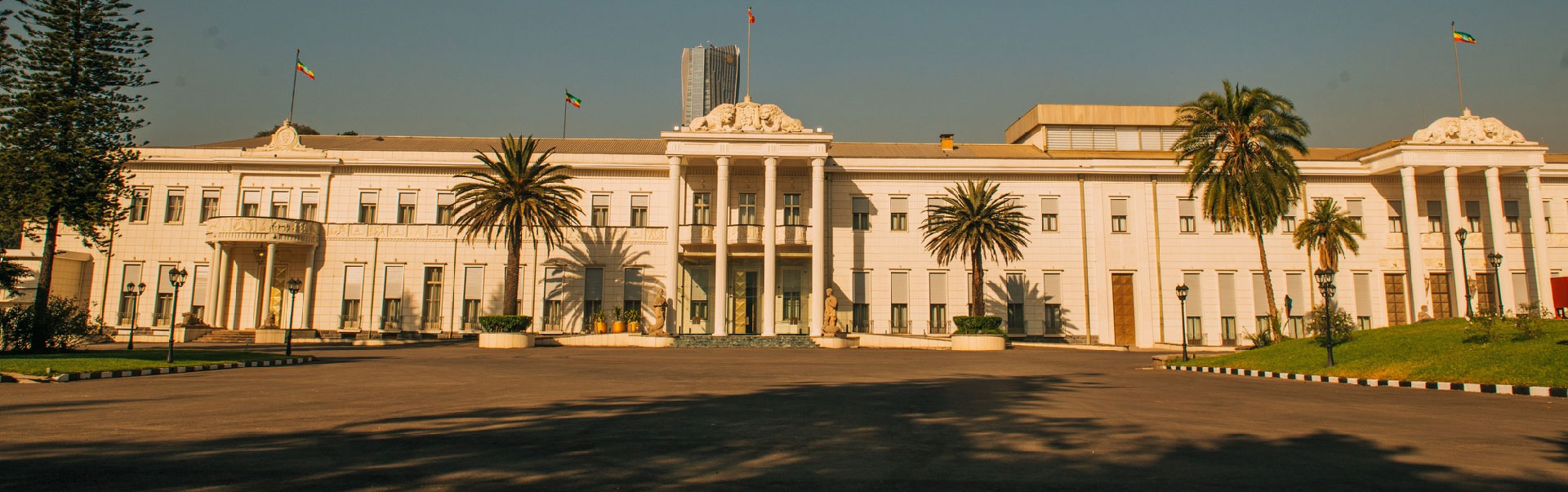
The two palaces in Addis Ababa are among the must see if you have a day or two. The Jublee Palace of Haile Siulassie and the Menelik palace now Unity Park each takes you from a half to full day tour.
The Jublee Palace is now a museum showcasing treasures of Emperror Haile Silassie whilst Emperor Meneliks Palace is a huge area that showcases Ethiopia’s almost everything. It also has a zoo and a small aquarium.
The palace compound is situated on top of the highest hill in Addis Ababa, overlooking the city in every direction. The whole compound is approximately 400,000 square metres.
Just opposite to the Unity Park, you will find Friendship Park, one of the most beautiful spots in the capital. Friendship Park is a hotspot for wedding parties and for people across the country to relax and watch a spectacular water fountain show.
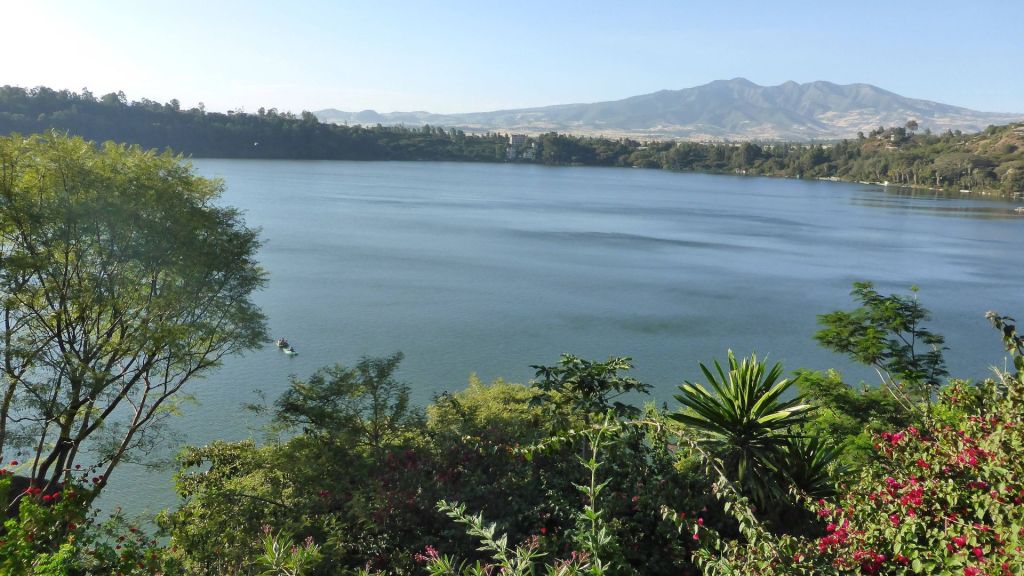
Excursion to Bishoftu Crater Lakes
Bishoftu is a native Oromo name for the little town nowadays called Debre Zeit. Only 50 km. from Addis Ababa, with a population of 50,000, Bishoftu is rapidly expanding.
lt is the site of the air force base and the veterinary institute. At an altitude of 1,900meters it enjoys a warmer climate than the capital city.
Bougainvillea, flame trees and frangipani brighten the streets. Bishoftu lies within a circle of five crater lakes and is a popular weekend resort for Addis Ababa residents.
Just before entering the town on the right side of the road (42 km. from Addis) there is a fruit juice cafe where refreshing drinks of papayas, orange, strawberry and grape juice, as well as fresh fruits and vegetables and some tinned foods, are on sale.
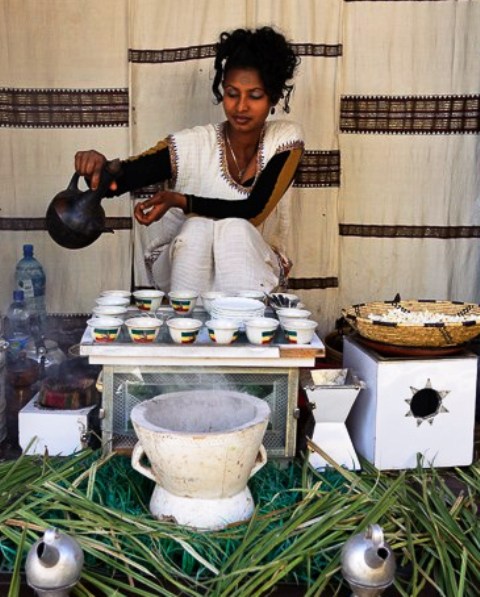
Join the Famous Ethiopian Coffee Ceremony
Ethiopia is a country where coffee is originated from. Witness the coffee ceremony from roasting the seeds to the brewing and drinking three rounds.
Some enjoy it bitter, whilst others with sugar, honey, salt and butter. coffee is a family drink in Ethiopia, a sign of hospitality and an integral part of the culture. The preparation ritual is usually officiated by the women of the house.
The ceremony follows specific, prescribed steps that are surprisingly similar throughout the country. The coffee beans are roasted on a metal plate or in a kind of saucepan over the stove.
When the smoke begins to rise from the roasted beans, the hostess extends the beans towards the guests so the could wave their hands to fan the smoke towards them, expressing the pleasure of inhaling the delicious aroma.
Addis Ababa Day Trips, Short Stays, Excursions
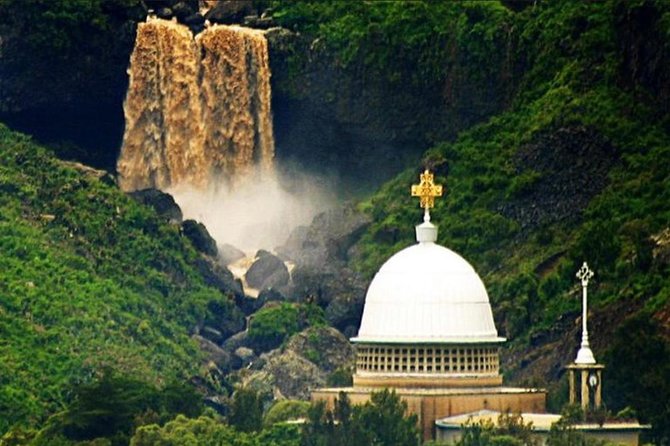
Debre Libanos Monastery
Debre Libanos 103 Km. to the north from Addis Ababa, a right hand tum leads to the ancient monastery of Debre Libanos.
This is the beginning of the true gorge country for which the central highlands are renowned. Breath-taking views over chasms with a depth of 2,000 ft. or more. The old monastery itself is situated behind the new church to the right high up on the cliff.(Women are not permitted to enter).
The first Abbot of the monastery was one Tekle Haymanot (1260)later canonised. The Abbot is titular head of the monastery and has always been regarded as the premier monk of the land.
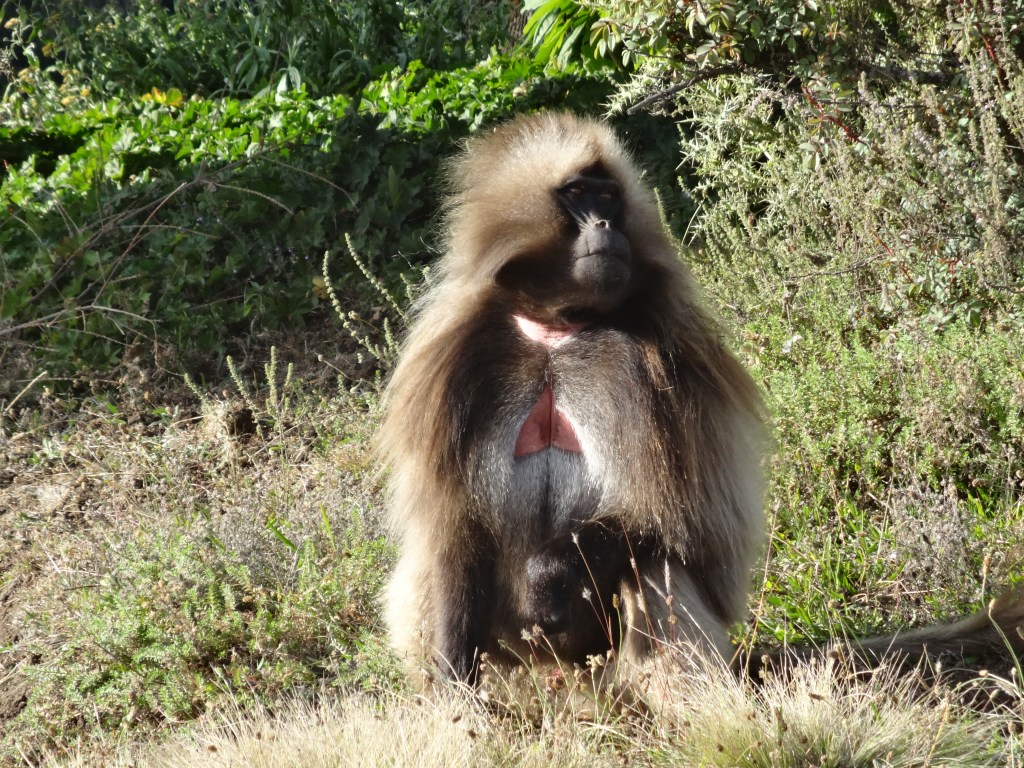
Enjoy Endemic Wildlife in the Blue Nile Gorge
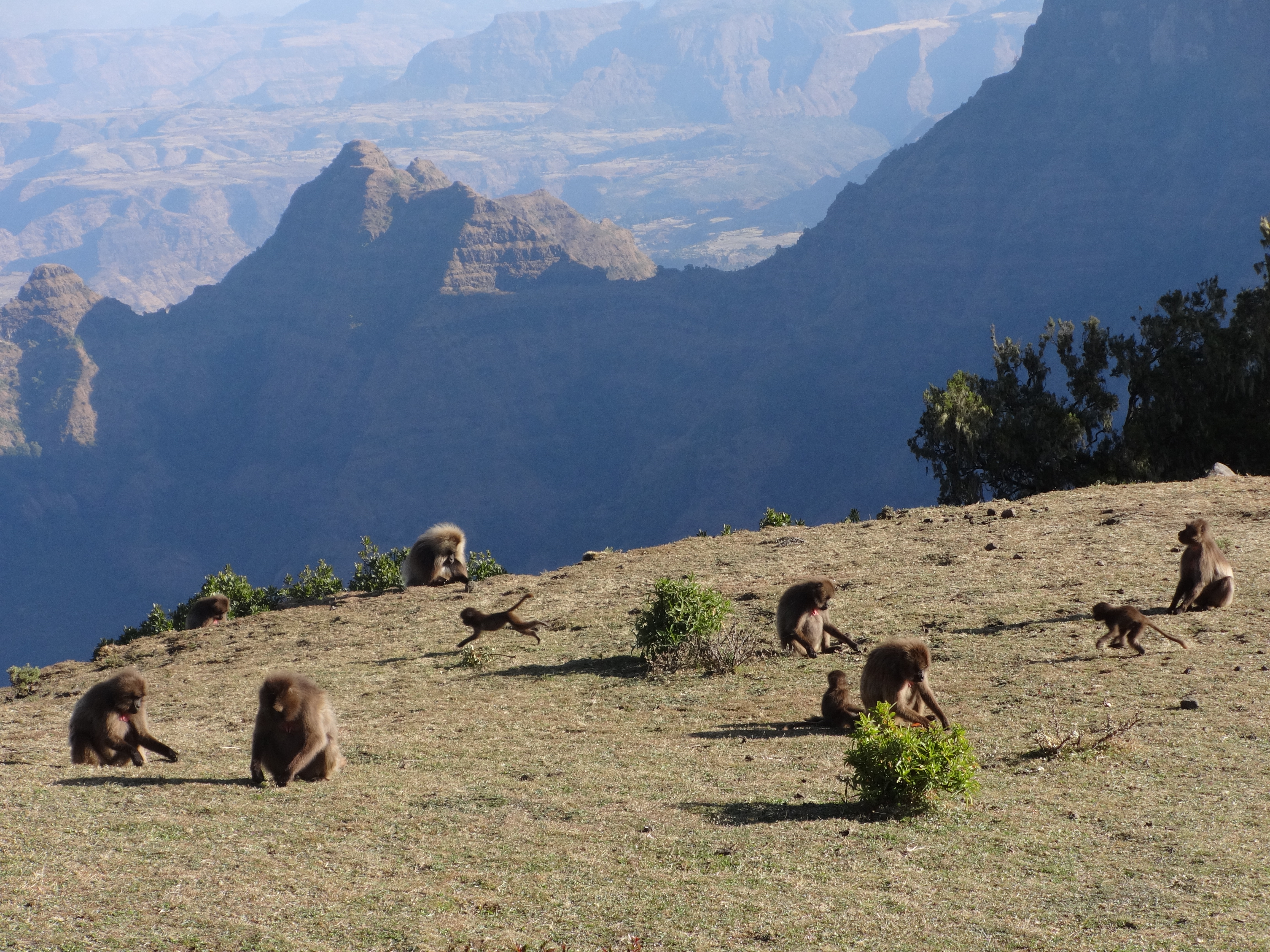
You can stop and spread a picnic lunch halfway between the turn off and the church. Gregarious gelada baboons peer curiously at the visitor while birds of prey soar overhead.
The great Abbay River flows out of Lake Tana and cascades over the famous Blue Nile Falls (Tis Issat),then winds for about · 500 km. through some of the most spectacular gorge country in the world. There are guards on the bridge and photographing is forbidden.
The 224 km.(140 miles)drive to the bridge itself from Addis Ababa and back on the same day is possible but not advisable. If you have a day to spare, it is worth climbing out of the gorge on the far side and spending a night at Dejen.
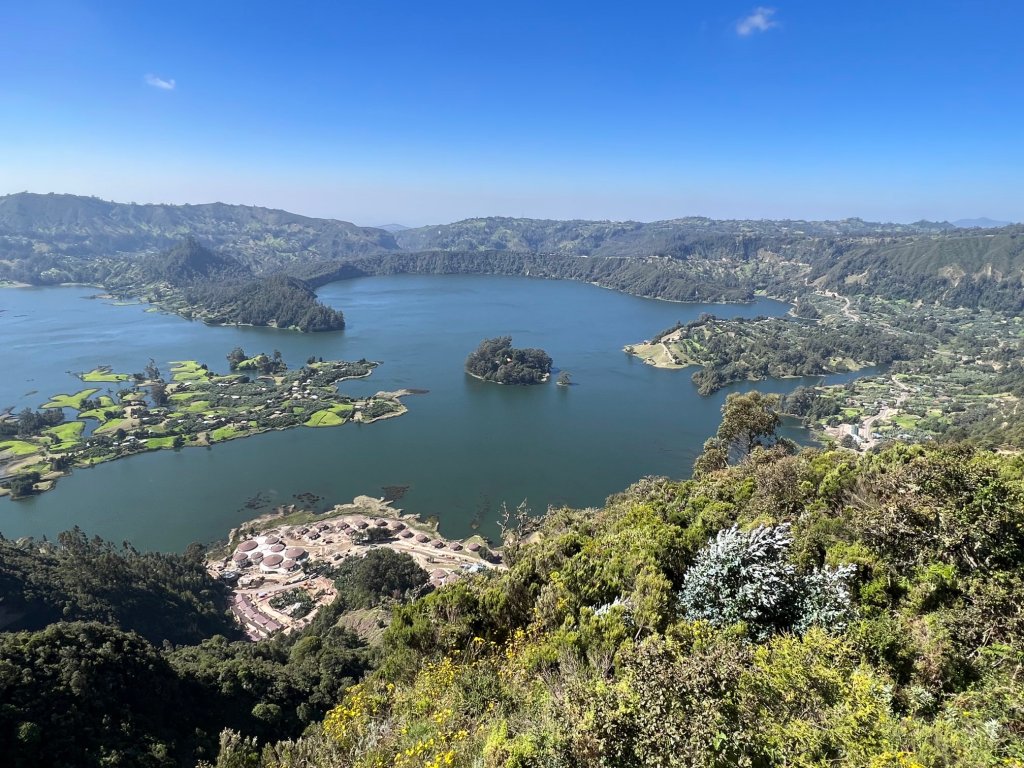
Excursion to Wenchi Crater Lake
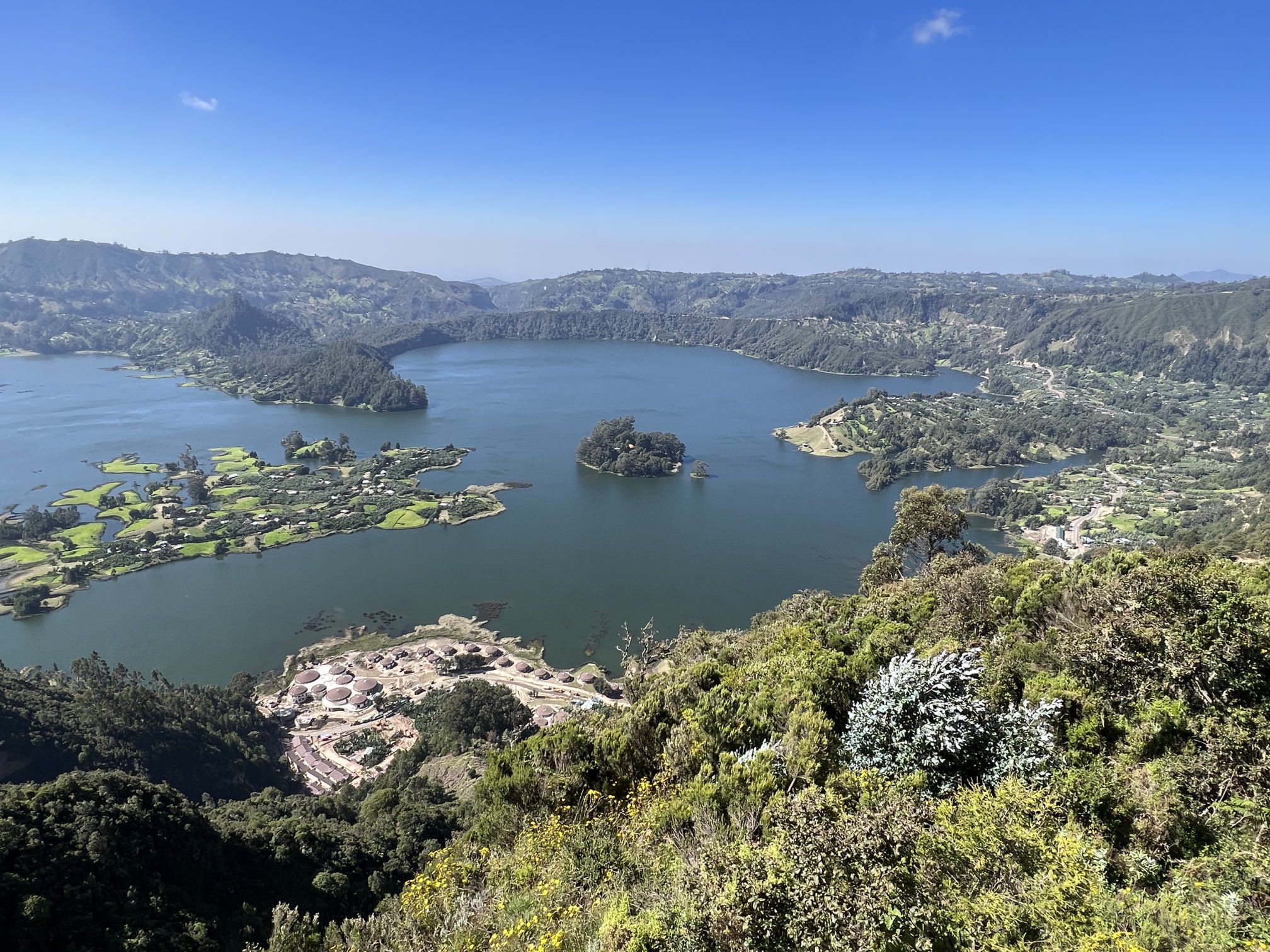
Wonchi crater lake is situated 157 kms South-west of Addis Ababa. Covering an area of 560 hectares, the lake and its surrounding are one of the best sights for nature admirers.
Wonchi Lake has a beautiful island and a church which many flock to celebrate on certain days of the year. The lake is something surreal view that makes your visit a lifetime experience.
Just 32 kms south you will explore Ambo where a hot spring swimming pool surrounded by lawns and shady trees makes an ideal camping site for an overnight stay.
However, Ambo lies only two and a half hours’ drive from Addis Ababa in a good road and the trip can, with an early start, easily be managed in one day.
Addis Ababa Short Stays, Holidays and Vacations
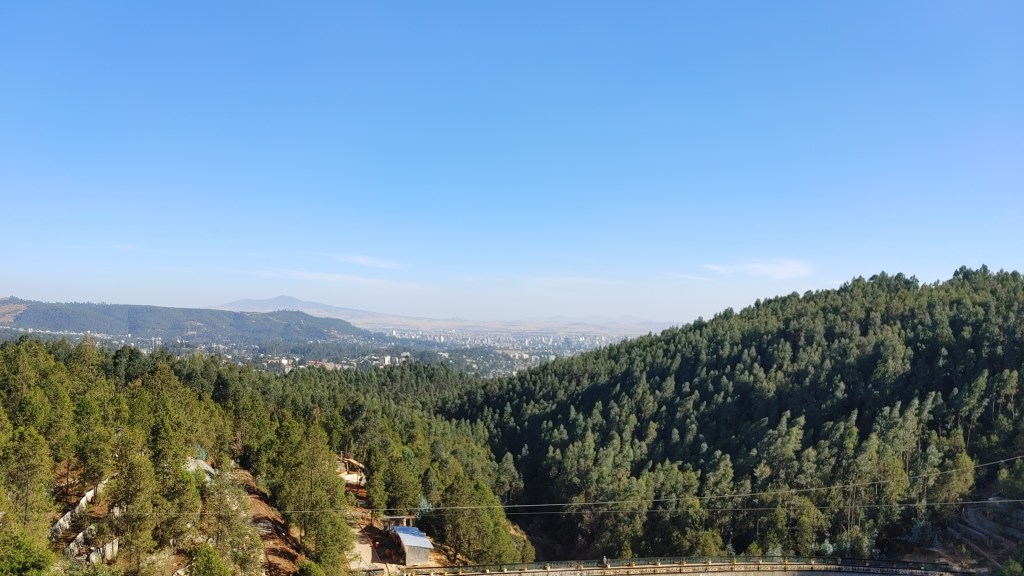
Entoto Mountains and Forest
Menelik selected Entoto as his new residence, following the old tradition of earlier monarchs. The first church in Addis Ababa was built in Entoto, once it was made Menelik’s capital, was St Mariam.
After the foundation of Addis Ababa, during the church’s annual celebration in the month of October, the emperor and empress, accompanied by their entourage, used to travel to Entoto to attend the ceremony and spend the night there.
The newly designed Entoto Park is one of Addis Ababa’s highlights whish is a hiking destination and loved as one of the best view points to enjoy the view of city from on top.
At Entoto you will visit a small museum in St Mariam Church and the old palace of Menelik.
Alfred llg, who was Emperor Menelik’s Swiss advisor, was a resident of Entoto when he directed the construction of the small palace and Raguel, the second church to be built at Entoto.
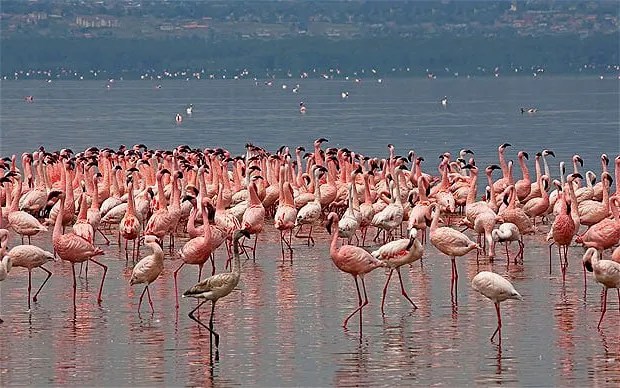
Explore Great Rift Valley Lakes
At about 160 km. there are several turnoffs leading to the lake shore. The largest of the five lakes, Ziway is 26 km.long and 18km.wide.
Several islands dot the surface. Tall fig trees line the original shore, but in recent years the level of the lake has dropped to such an extent that several hundreds of metres of grassland and reeds come between you and the water.
Marabou storks roost on the tops of the acacias in the evenings, and many other birds have made the grassy stretch their feeding area: knob-billed geese, pelicans and an occasional saddle-bill stork.
The soft brown waters of Langano are set against the blue backdrop of the Arsi mountains soaring to 4,000metres.
A few birds make Langano their home, but this resort is less for the nature lover than the sportsman and sunworshipper. Here you can water-ski and sail, swim or bask in the blazing sun on the sloping sandy beach.
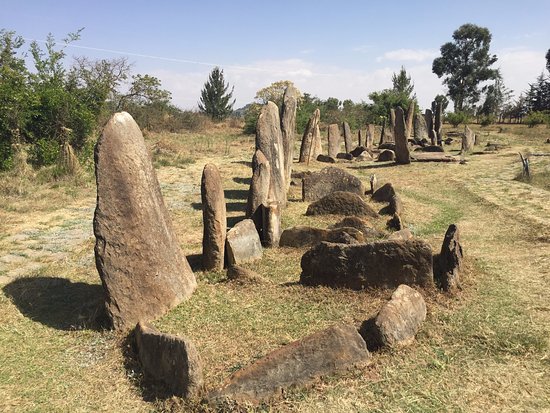
Excursion to Tiya Steles and Melka Kunture
The 13 century steles at Tiya, just 82km south of Addis is one the excursions you can join if you are keen to historic sites.
Tiya stales are registered by UNESCO as a world heritage sites. They are believed to be burial sites and the steles are erected as tombstones.
Next, you will explore Melka Kunture an archeological site in the upper course of the Awash Valley. It is a Palaeolithic site where the continuous evolution of stone utensils can be seen, from 1.7million to 150,000 years old.
At Melka Konturé also were discovered fossil bone of the hippopotamus, rhinoceros, elephant and various antelope.
Since 1965,from October to January each year, geologists and archaeologists have been camping by the awash river at this point.
It’s believed two million years ago at the entrance to the gorge lived some of the earliest ancestors of mankind.
More Interesting Facts About Addis Ababa City and Surroundings
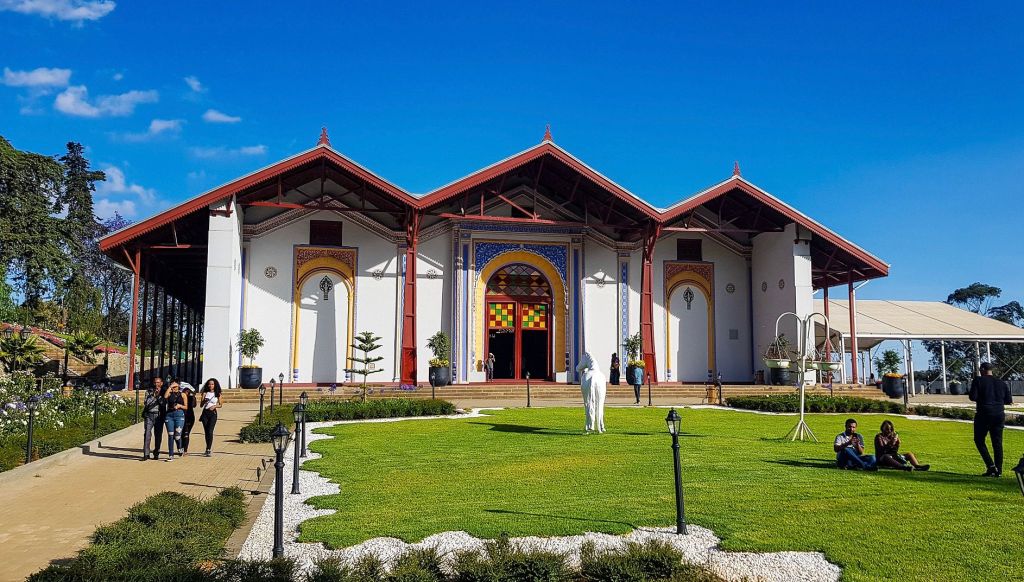
The Imperial Palace of Menelik
The compound was first fenced with a makeshift wall surmounted by a cover of thatch. Later, during the reign of Emperor Haile Selassie, a stone masonry wall with metal railings was put up.There were seven gates, each having a distinct purpose, namely, the ltegue ber (the queen’s gate); the Chariot gate; the Fit ber or front gate; the Treasury gate; the Grain gate; the Qidus Gabriel gate and the Abattoir gate.
The palace had to be rebuilt due to a fire in 1892, and in November of that same year the reception hall and the banquet hall were constructed. In 1893, the Swiss engineer Alfred Ilg installed the first pumped water supply system by connecting pipes from Entoto to the imperial palace compound. And in 1905, electric power was provided to the imperial palace with the help of German envoy Friedrich Rosen.
Right after the victory of Adwa, Emperor Menelik started the construction of a large banquet hall for his soldiers. Indian craftsmen were put to work under the supervision of Alfred llg and another European, Léon Chefneux. The roof of this banquet hall had three gables running side by side, with fifty finials surmounted by ostrich eggs on each ridge. There were thirty-four wooden columns in two rows be-tween the three aisles, supporting the roof.
The central aisle was named Shewa, the right one Tigray and the left one Gojam, in reference to the northern regions of Ethiopia. The building had twenty-three windows on its northern and southern walls. The banquet hall, centrally located in the imperial compound, faced the south-west, where lay the main entrance, guarded by armed soldiers and a cannon. The entrance doors were of iron, with a curved stone canopy. During that period, the banquet hall of Emperor Menelik was the largest and most attractive hall in the country.
Selassie, besides the important dignitaries, the aderash could accommodate 7987 guests and 380 servants at a time. During royal feasts the aderash was used five to six times within a day to cater to the large number of people coming from the city as well as from the countryside. Tej was served by piping it directly from the palace brewery with a three hundred meter long tube.

Between the main gate of the gebbi and the entry of the banquet hall there was a large public space subdivided into several areas more or less separate from each other. Each of these spaces had its own function but people could freely wander from one to the other. Right in front of the banquet hall described earlier, was a large square filled by guests and dancers on feast days. But it was the square in front of the reception hall and the clock tower that saw the most daily commotion.
New royal decrees and proclamations were announced to the public by beating a large drum (the negarit)in this square. In this same forum, judges heard and deliberated on cases brought to them. In the centre of the square a water fountain coming from the piped water system served the guests and the public. People quenching their thirst expressed their wonder at the fact that part of the pipe was made to go uphill. A corner of the square was devoted to keeping lost goods and animals so that their owners could retrieve them easily.
On the other side, towards the banquet hall, there was another square, used for high level government functions. This is where the court of the Afe Negus deliberated and the prison for the nobility stood. Finally, in the open space in front of the imperial residence was the imperial plaza. The elfign, which is part of the imperial residence, was used for receiving foreign guests and holding banquets for important dignitaries and guests. Royal family members and nobles dined in the imperial residence itself, seated according to their rank. It was also theplace where young aristocrats observed and learned court customs.
A low tunnel leads into the courtyard and you can then see the still-standing double entrance gate. Although the ceiling has long since fallen in, the remains of windows and other architectural details are discernible. If is possible to approach fairly close to the church in a four wheel drive vehicle up the track between the British Embassy and new St. Michael’s. But riding or walking is often preferable-allow two or three hours for the trip to give yourself time to enjoy the marvellous views over the city and countryside.
Other interesting sites while you are on Addis Ababa Excursions
Thermal Springs of Filwoha
The hot springs of Filwoha, on the lower slopes of Entoto, were a major attraction to Menelik and his wife Taitu. Tents used to be set up near the hot springs in a traditional royal camp layout. They often spent days by the hot springs with their royal entourage. It was widely believed that the Filwoha hot springs had curative powers, and people came there for treatment. Ethiopians had long recognized the medicinal value of such hot springs for rheumatism, leprosy and several other illnesses.
Filwoha and its surrounding area were better forested than Entoto. Empress Taitu was particularly interested in building a permanent residence by the Filwoha springs and convinced her husband to do so. Menelik was at first reluctant, but later agreed to her request. It is from the mimosa trees in this area that Taitu gave the new settlement its name, Addis Ababa, literally meaning ‘new flower’.
Upon his return from the campaign to the south-east of the country, the emperor was surprised to see the number of buildings under construction above the Filwoha area. These structures were later to become the first buildings of Addis Ababa, the new capital. In the 1920s and ’30s, the Filwoha springs became part of the Hôtel d’Europe, a popular venue where the affluent went to have hot baths. This hotel is today known as the Finfinne and forms part of the Filwoha hot baths.
Yeka Michael
Addis Ababa is surrounded by hills in which ancient dwellings and places of worship are continually being discovered. Either natural caves or buildings hewn from the rock, these remnants of bygone civilizations, offer a challenge to the explorer. Yeka Mikael rock church is located on the hill rising behind the British Embassy. It is carved from rock as were the Lalibela churches, and was used during the Italian occupation to harbour the Tabot of St. Michael which was later returned to the new church of St. Michael on the Dessie road below.
Legedadi Dam Reservoir
Leaving the city by. the Dessie road, one of the first places of interest is the dam on the Legedadi River, supplying Addis Ababa with most of its water. Turning to the right at 20 km. out of town, a long gravel road runs down to the lake created by the damming of the river. Already, since 1970 when construction
On the Dessie road was completed, myriads of waterbirds have made he lake their home. A small bar serves refreshments and by special arrangement with the Water Resources Development rooms may be booked at the guest house for overnight stays. After Legadadi the main road continues to Debre Birhan. There are many picturesque spots for picnicking along the way as the road gets nearer to the edge of the escarpment. At about 50 km., just past Sendaffa, the deep gorge of the Kesem river is visible to right and can be reached by a track suitable for most cars during the dry season.
Awash Bridge and Falls
Continuing down the road en route to the bridge over the Awash you pass the radio transmitters of the Radio Ethiopia. The drive itself is not in fact as rewarding as most-the road passes through tussock grassland and semi-desert scrub. However, the falls themselves are worth a visit. For a better view, it is possible to climb down from the bridge along the little track leading to an old mill.
Shala and Abiyata National Park
The trail to lake Shala is now the main trail through the national park. It turns right off the main road at 215 km. directly opposite the turning to Bekele Mola. You drive in and follow your nose and the reason-ably good track which leads first to a spectacular lookout point with a view over densely forested country and both Abyata and Shala. From here you descend the small escarpment and enter the acacia woodland which clothes the shoulder running be-tween the two lakes. Birdlife is profuse: the bright yellow Masked Weaver, the red rumped Buffalo Weaver, Red-billed Hornbill, African Fish Eagle, Abyssinian Roller, Superb Star-ling; the woods teem with flashes of brilliant colour and resound with birdsong. The track emerges at the lake shore of Shala where again a vast profusion of ducks, geese, coots, waders, shore birds of every kind mingle with flamingo and pelican at the water’s edge.
It is possible now to make the tour of the lake (Shala) which is one of the more spectacular; on the north side a tumbling cascade sixty metres high, rushes from the rocky hillside down to the wide bay. Tilapia reach a fair size and can be cooked over the camp fire at one of the beautiful camping sites along the lake. You will enjoy this lake less for its swimming the water has a peculiar alkaline flavour-than for its atmosphere of un-touched natural beauty and its splendid variety of shoreline and colour, and its prolific birdlife.
Shashemene Ras Taffarians Village
You pass through the bustling town of Shashemane (one of Ethiopia’s rare road junctions, where the left turn before the town leads to Bale, and the right turn in the centre leads to Arba Minch.)Shops line the busy high street and most of the town’s business appears to take place in the centre of the road ·where horse drawn gharries narrowly miss the gesticulating traders and truck drivers. Between Awasa and Shashemane a government farm project with great cultivated areas of sisal, sunflowers and groundnuts lines the road on either side for many kilometres.
Wendo Genet
Just after the town of Shashemane a modern Tele-communications building stands on the left of the road and immediately there is a signposted turning to the small paradise of Wendo Guenet. The road winds for 15 km. through increasingly beautiful country until you reach the lovely wooded valley in which the lodge is situated. Turn left in the village market square to ascend the track to the lodge. An avenue of Cyprus trees tells you when you are there and the entrance is just a little further on the left. The lodge is set in gardens of citrus, palm and pine with a magnificent view from the terrace over the Rift Valley.
You bathe in natural hot springs and a small hot pool which lie only a few metres from a cold clear rushings mountain stream. Walks up the valley or in the surrounding forest give a spectacular view and a chance to observe the abundant birdlife. Areas of indigenous forest are the home of the beautiful colobus monkey. The lodge provides comfort able modern accommodation, the food is excellent, but the Sunday buffet lunch must be particularly recommended.
Hawassa City and Lake Hawassa
At about 275 km. from Addis Ababa a gravel road on the right runs along the shore of Lake Awasa to the two or three resort hotels. The luxury Awasa Hotel, is the most comfortable. Simpler accommodation at the Bekele Mola Hotel, and the more interesting Belle Vue du Lac (also with swimming pool and a tennis court) is quite adequate. Fishing and boating are favourite pastimes on Lake Awasa, although again the birdwatching,if not as spectacular as Abyata, has its own special attractions.
Koka Dam
By-passing Mojo on the main road, you keep straight on toward Nazret. At the site of the new dam across the Awash river, perched on the steep hillside is the little village of Koka. To reach it you turn right off the main road to Nazret. Then you cross the dam itself and drive up the far side to the Koka Hotel, which is set high on the hill overlooking the lake, and is surrounded by an oasis of green shady trees and tropical plants.
But if you want to see the hippos at play you must drive the few kilometres to the confluence to the Awash with the hot spring river. Where the hot blue water meets the cooler brown, an interesting sight in itself, an abundance of fish leap and splash, this in turn attracts crocodiles and you can usually see one or two under the overhanging bushes on the far bank. Further down-stream about fifteen hippos play with their young ones. You can continue on this track through the Wonji Sugar Estate and come back to the main road just before Nazret.
Adama Nazret City
Adama or Nazret is one of the biggest cattle collecting points in the country and a fast growing agricultural and commercial centre. Near to the Wonji Sugar Estate, and encompassed by plantations of papaya and citrus fruits, the town lies in a warm valley; the streets are bright with bougainvillea blossom, flame trees and frangipani lending scent and colour to the balmy air. In addition to Adama Hotel, built round a central swimming pool, several hotels of a tourist standard are found as the place is a favourite of the Addis Ababa residents, especially during the rainy season, who come down for a day or a weekend just to sit the warm air on the vine-covered verandas.
Sodore Resort
Just 120 km. from Addis Ababa (a two hour drive) lies the resort area of Sodere. Turn right at Nazret after the Agip station and left at the little village which has grown up round one of the dams of the Awash river. Sodere itself takes advantage of the volcanic mineral springs which bubble to the sur-face to fill its two blue swimming pools with clear warm water, and of the nearby Awash river which lends a part of its riverine forest in the form of giant shade trees.
Swimming and relaxing are the objects of most people’s trip to Sodere, but for the energetic there are good walks in the countryside-vervet monkeys and baboons play in the riverside trees; crocodiles and hippos are frequently seen in this stretch of the Awash; and as everywhere in Ethiopia the birds are practically too numerous to mention…Go-away-Birds fascinate with their typically African call, as does the African Fish Eagle; huge vultures construct their platform nest high up in the riverside trees; bright blue iridescent starlings strut cheekily through your camp or yellow weavers fly past carrying long strands of grass for
the construction of their amazing nests.
Awash National Park
Less than three hours’ drive from Addis Ababa, or one and a half from Nazret is the Awash National park and Game Reserve. The main entrance is at the 190 km. mark and you have already passed the park boundary as you crossed the railway track just before Fantalle Crater, which rises 600 m. from the valley floor on the left. At this point there is a track to the left and it is possible to drive either up to the crater rim or right round the park to the hot springs …although the road is such that the prospect will not tempt everyone.
It is probably wiser to enter the main gate first and travel comfortably down to wards the Awash river which constitutes the south-ern boundary of the park. Here is park Headquarters, sited near the dramatic Awash falls where the river enters its gigantic gorge. A small bar and museum are conveniently near the camping site. The main lodge is several kilometres away across the Ilala Sala plains: perched on the very rim of the gorge are several luxurious airconditioned caravans and just on the edge, a restaurant and small swimming pool.
The park itself is traversed by a series of well-maintained tracks which take in the most spectacular of the many scenic attractions. It is possible, and perhaps advisable, to hie a park guide for a fee of 10 Birr or so. To the north lies the hot springs oasis in its groves of palm trees. It is reached by either one of two scenic tracks which start opposite the main gate on the far side of the road and bearing right, progress either along the floor of the Awash Falls beautiful lower kudu Valley, or along the top of the ridge.
At all places and all times it is possible to see game: oryx, Soemmerring’s gazelle, wild pig with their little tails carried high over their backs. Slightly less frequent are the furry waterbuck which tend to appear near the river in the late afternoon. The tiny dik-dik, not easy to spot in the speckled shade of the acacia thorn, zebra grazing the plains to the west of Fantale, cheetah, serval and leopard are also there but it is not easy to spot them; baboons, both anubis and hamadryas, the beautiful kudus, lesser and greater, the giant tortoise, his shell a work of art, plodding along the track.
Nimble klipspringer inhabit the higher slopes of the mountain and curious hyrax peer at you curiously from behind their rocks. In the bottom of the gorge, where few venture, with good binoculars, you can spot the colobus monkey in his contrasting black and white coat. Perhaps as interesting is the astonishing wealth of bird-life.
Over three hundred species are recorded for the park: (The check list is avail-able at the museum at park Head quarters).They range from the great ostrich, frequently and easily observed, and the less common Secretary Birk and Abyssinian Ground Hornbill, to the flashes of brilliant pink which are the Carmine Bee-eaters, and the Abyssinian Roller with turquoise and purple wings. And between these two extremes, birds of the riverine forest, Coucal Turaco, Go-away Birds; birds of prey; birds of the savannah.
Ankober Town and Palace
Before the establishment of Entoto and then Addis Ababa, Ankobar was the capital of Menelik and his court. Later, during the earlier part of the 20th century, Ankobar was still the largest town in Shewa after Addis Ababa. Some of the earliest architectural types of the ‘Addis Ababa style’ were first built in Ankobar. Ankobar was founded as a permanent settlement by Negus Sahle Selassie of Shewa, the grandfather of Emperor Menelik and father of Negus Haile Melekot of Shewa.
Sahle Selassie,the son of Merid Azmatch Asfa Wossen, who claimed descent from the Solomonic line, became Negus of Shewa in 1813. Negus Sahle Selassie, like his ancestors, built several churches and palaces in Ankobar. After founding the Ankobar Mikael Church in 1823 and the Afer Bayene Tekle Haymanot Church in 1828, he established a customs collection point at Aliyuamba. According to local informants, Qidus Mikael was the third church to be built in Ankobar, and its tabot was brought from Gondar.
The church of Medhane Alem was constructed by builders who were brought from Gondar, where a few skilled craftsmen remained from its earlier rich building tradition. Lime was introduced as a construction material for building palaces and churches, while locally produced steel was being used for the production of tools and other utensils. Negus Sahle Selassie also constructed bridges over the Ayrara and Beresa rivers.
The town of Ankobar became an important administrative centre with a bustling urban life during the reign of Sahle Selassie. Traders from Gondar and Tigray and people from different ethnic backgrounds used to live there. Even though the majority of the population consisted of Christian Amharas, there were also some Muslims. A few thousand slaves also used to work at the imperial palace. Sahle Selassie was buried in his favorite church of Mikael, whose tabot traveled with him during military campaigns. Diplomatic relations were also formed with Britain, France and Italy, and representatives of these European powers resided in Ankobar.

Prince Menelik, after escaping from Tewodros’ mountain redoubt of Magdala, returned to Ankobar, the capital of his ancestors. But as the town of Ankobar was located at the top of a mountain it was hard to supply with water. Oral history says that Menelik had a pond at the top of the hill which was apr used during fire accidents and later installed a piped water system downhill at a place called Chefa. This spring is still known by residents of the area as Menelik’s water.
Menelik then left Ankobar for Debre Berhan and later Leche, which he made his temporary capital. Menelik once more returned to Ankobar in 1878 and his wedding to Taitu is another important event that took place in Ankobar Medhane Alem Church. But,after having tried to revive the town, the court was to leave it for good.
For strategic reasons Menelik moved to Entoto, the range of l’a hills just north of actual Addis Ababa, from where he could undertake his campaigns to the southern part of Ethiopia. But even after his coronation, the Emperor did not forget Ankobar. He opened a school there where Coptic Egyptians taught local children. In spite of the efforts of Menelik to introduce a postal system and telephone line to the small settlement, the nobility and the clergy refused to use the latter claiming that it is the work of the devil.
What completed the destruction of Ankobar was the battle between Negus Mikael of Wello and the Shewan army, of the Segele campaign of 1916 and later the destructive wars waged by the fascist Italian army in 1936.After destroying Ankobar, the Italian army set camp in neighboring Gorebela. Ankobar town quarters were known as Serategna Sefer, Beklobet, Tiyit Bet, Laye Arada, Tach Arada. It is interesting to note that Addis Ababa adopted the same names for some of its streets and quarters.
Today some of the ruins of a wall can be seen next to a newly C built restaurant known as the Amba Ankobar lodge. This oval structure is built of traditional materials and follows the original layout of Menelik’s palace. The residence of Menelik was a double story structure of which the lower level was used as a prison for exiled members of the nobility.
The large eucalyptus trees, which are found around the Qidist Mariam and Qidus Giorghis churches were brought and planted during the reign of Emperor Menelik. The two acacia trees within the compound of Qidus Mikael church are believed to have been brought from Jerusalem and planted by Negus Sahle Sellasie.


 Ethiopian Treks